
High Gold Prices: B2B Jewellery Partnership Strategies 2026
Gold prices have always played a crucial role in shaping the jewellery industry, but the landscape in 2026 presents a challenge unlike anything many retailers and manufacturers have experienced before. With continued gold price volatility across global markets, businesses are facing increasing pressure on procurement costs, inventory investments, and profit margins. What was once a predictable operating environment has become a complex balancing act between maintaining sales, protecting profitability, and meeting changing customer expectations.
If you are a jewellery retailer, you have likely noticed the effects firsthand. Customers are becoming more price-sensitive, purchasing decisions are taking longer, and inventory commitments carry greater financial risk. At the same time, manufacturers are navigating rising raw materials pricing, fluctuating demand patterns, and the need to deliver products that align with evolving market realities. In this environment, traditional buyer-supplier relationships may no longer be enough to support sustainable growth.
So, how can jewellery businesses continue to thrive when High Gold Prices are reshaping every aspect of the industry?
The answer increasingly lies in stronger B2B Jewellery Partnership models. Rather than operating as separate entities focused solely on transactions, forward-thinking retailers and manufacturers are building collaborative relationships that prioritize shared planning, inventory efficiency, cost management, and market responsiveness. These partnerships are helping businesses reduce exposure to risk while creating new opportunities for growth, even during periods of significant market uncertainty.
As the jewellery industry adapts to high gold prices, successful companies are rethinking everything from procurement strategies and inventory management to product development and customer engagement. Lightweight collections, flexible financing options, faster supply chains, and data-driven decision-making are no longer optional advantages—they are becoming essential components of long-term competitiveness.
In this article, we will explore how high gold prices are transforming retailer-manufacturer relationships, examine the most effective B2B jewellery wholesale strategies for 2026, and uncover practical approaches that can help both retailers and manufacturers protect margins, strengthen partnerships, and position their businesses for sustainable success in a rapidly evolving market.
Understanding How High Gold Prices Are Reshaping the Jewellery Industry
The Current Gold Price Environment in 2026
The jewellery industry has always been closely tied to the movement of gold prices, but 2026 has introduced a level of uncertainty that few businesses can afford to ignore. As High Gold Prices continue to dominate industry conversations, retailers and manufacturers alike are being forced to rethink long-established business practices.
The challenge is not simply that gold is expensive. The bigger concern is the ongoing gold price volatility jewellery industry participants are experiencing. When prices fluctuate rapidly, planning becomes more difficult, purchasing decisions become riskier, and maintaining healthy margins becomes increasingly challenging.
For many jewellery businesses, the key question is no longer, "Will gold prices rise?" but rather, "How do we operate profitably in an environment where prices can change significantly within a short period?"
This shift is influencing every stage of the business cycle, from sourcing and manufacturing to inventory planning and customer sales strategies.
Impact on Retailers, Manufacturers, and Supply Chains
The gold price impact jewellery retail businesses face today extends far beyond product pricing. Rising costs create a ripple effect throughout the entire jewellery supply chain.

Retailers are encountering:
Higher procurement costs when replenishing inventory
Increased capital requirements to maintain stock levels
Greater pressure on working capital and cash flow
Difficulty balancing competitive pricing with profitability
Meanwhile, manufacturers are dealing with:
Escalating raw materials pricing
More cautious retailer purchasing behaviour
Increased demand for flexible production planning
Pressure to deliver cost-effective designs without compromising quality
The jewellery supply chain high gold prices environment has also highlighted the importance of stronger coordination between retailers and suppliers. Businesses can no longer rely solely on historical buying patterns. Instead, they must make faster, data-driven decisions that align inventory levels with real market demand.
As a result, agility has become one of the most valuable competitive advantages in the industry.
Why Traditional Business Models Are Under Pressure
For decades, many jewellery businesses operated using predictable inventory cycles, stable purchasing schedules, and long-term assumptions about customer demand. However, those models are being tested in today's market conditions.
One of the biggest concerns facing retailers is the growing margin squeeze jewellery shops business owners are experiencing. Every increase in gold prices raises the cost of carrying inventory, yet customers may not always be willing to absorb those increases immediately.
This creates a difficult balancing act:
Increase prices too aggressively, and sales may slow.
Hold prices steady, and profit margin levels may shrink.
Reduce inventory purchases, and product availability may suffer.
At the same time, high procurement costs jewellery retailers face are making inventory decisions more strategic than ever before. Every purchase now carries greater financial significance, requiring businesses to evaluate not only what products sell, but also how quickly they sell and how efficiently they generate returns.
The reality is that rising gold prices jewellery business leaders are confronting today require a new mindset. Success is no longer determined solely by product selection or showroom presence. It increasingly depends on operational efficiency, supply chain collaboration, inventory discipline, and the ability to adapt quickly to changing market conditions.
The businesses that recognize this shift early and adjust accordingly will be better positioned to navigate uncertainty while continuing to grow in a high-price environment.
How High Gold Prices Are Changing Retailer–Manufacturer Relationships
From Transactional Buying to Strategic Partnerships
For many years, the relationship between jewellery retailers and manufacturers was largely transactional. Retailers placed orders, manufacturers fulfilled them, and both parties focused on their individual business objectives. However, High Gold Prices have fundamentally changed this dynamic.
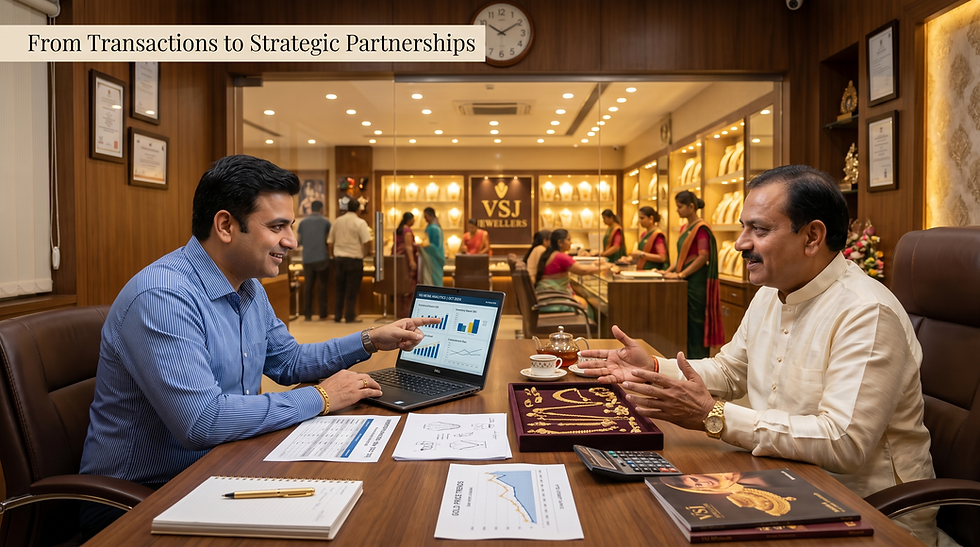
Today, a successful retailer manufacturer partnership jewellery model requires much more than simply exchanging products for payments. Both sides are facing the same market pressures—higher inventory costs, fluctuating demand, and increasing customer price sensitivity. As a result, collaboration is becoming a business necessity rather than a competitive advantage.
Consider this question: when gold prices rise unexpectedly, who absorbs the risk?
If retailers bear the entire burden, profitability suffers. If manufacturers absorb all the pressure, production sustainability becomes difficult. The most resilient businesses are finding a middle ground through stronger B2B Jewellery Partnership structures that create value for both parties.
Instead of focusing solely on purchase orders, leading retailers and manufacturers are now collaborating on:
Product planning and assortment strategies
Demand forecasting
Inventory optimization
Market trend analysis
Sales performance reviews
Cost management initiatives
This shift transforms suppliers into strategic growth partners rather than simple vendors.
Shared Risk Management in a Volatile Market
One of the biggest consequences of gold price volatility retailer procurement strategies must address is uncertainty.
When prices move rapidly, businesses often struggle with questions such as:
Should inventory be purchased immediately or delayed?
How much stock should be maintained?
Which product categories deserve greater investment?
How can businesses avoid overcommitting capital?
The answer increasingly lies in collaborative decision-making.
Through jewellery manufacturer retailer collaboration cost management initiatives, both parties can share market intelligence and create procurement plans that reduce exposure to sudden price movements.
Effective partnerships often include:
1. Flexible Procurement Planning
Rather than making large purchases based on assumptions, retailers and manufacturers can establish phased procurement schedules that align with market conditions.
Benefits include:
Reduced procurement costs risk
Better cash flow management
Increased inventory flexibility
2. Collaborative Demand Forecasting
Manufacturers often possess valuable insights from multiple markets, while retailers have direct visibility into customer demand.
Combining these perspectives helps businesses:
Improve buying accuracy
Reduce excess inventory
Respond faster to market shifts
3. Product Mix Optimization
When gold prices rise, customer preferences often change.
Partnerships that regularly review sales data can identify:
Fast-moving categories
Emerging customer trends
Price-sensitive segments
New growth opportunities
This collaborative approach reduces uncertainty and strengthens profitability across the supply chain.
Building Long-Term Supply Stability
In a high-cost environment, supply reliability becomes just as important as product quality.
Many retailers have learned that constantly switching suppliers in search of marginal savings can create hidden costs, including:
Inconsistent product quality
Longer replenishment cycles
Stock shortages
Reduced market responsiveness
Instead, forward-thinking businesses are focusing on long-term relationships with trusted partners who can provide stability during uncertain periods.
A strong wholesale gold supplier retail-ready jewellery partnership delivers more than inventory. It creates access to predictable supply, faster production turnaround, and better alignment with changing market demand.
The most valuable partnerships often provide:
Consistent product availability
Faster replenishment cycles
Trend-driven product development
Improved communication
Better inventory planning support
Similarly, jewellery suppliers' faster delivery value has become a critical competitive factor in today's market. Retailers no longer benefit from carrying excessive stock when gold prices are high. Instead, they need dependable partners capable of delivering the right products at the right time.
This shift allows businesses to operate with greater efficiency while reducing the financial burden associated with large inventory investments.
The New Competitive Advantage: Partnership Over Price
Historically, many retailers selected suppliers primarily based on pricing. While pricing remains important, today's market conditions demand a broader perspective.
The most successful businesses are evaluating partners based on:
Reliability
Flexibility
Market understanding
Procurement support
Inventory planning expertise
Speed of execution
In many cases, the retailer-supplier collaboration jewellery value generated through a strong partnership far exceeds the savings achieved through short-term price negotiations.
As gold prices continue to influence purchasing decisions and operational costs, businesses that prioritize strategic collaboration will be better positioned to manage risk, maintain profitability, and respond quickly to changing market conditions.
The future of the jewellery industry may not belong to the businesses with the lowest prices. It may belong to those with the strongest partnerships.
Inventory Management Strategies for Retailers During High Gold Prices
Optimizing Inventory Cycles for Better Cash Flow
When gold prices are high, every gram sitting in your showroom represents a larger financial commitment than ever before. This reality has made jewellery retailer inventory management high gold prices strategies one of the most important factors influencing profitability in 2026.

Many retailers traditionally focused on maintaining extensive inventory to ensure customers always had a wide range of choices. While that approach worked well in more stable markets, today's environment demands a more disciplined strategy.
The key question is simple: Are you maximizing the return on your inventory investment, or are you tying up valuable capital in slow-moving stock?
The answer often lies in optimizing inventory cycles.
Efficient inventory cycles allow retailers to:
Free up working capital
Reduce carrying costs
Improve cash flow
Respond faster to changing customer demand
Minimize exposure to gold price fluctuations
Rather than viewing inventory as a static asset, successful retailers now manage it as a dynamic investment that must continuously generate returns.
Many businesses are adopting shorter jewellery inventory cycles and cost-efficient retail practices by increasing replenishment frequency while reducing excessive stock levels. This approach creates flexibility and allows retailers to adapt more quickly when market conditions change.
Balancing Stock Depth and Product Variety
One of the biggest challenges retailers face during periods of high gold prices is balancing inventory management with customer expectations.
Customers still want variety. They still expect to find products that suit different budgets, occasions, and personal styles. However, maintaining deep inventory across every category can create unnecessary financial strain.
This is where understanding customer buying behaviour becomes critical.
Today's jewellery buyers are increasingly selective. They spend more time researching purchases, comparing options, and evaluating value before making a decision.
As a result, retailers should focus on identifying:
Fast-Moving Product Categories
Products that consistently generate sales deserve greater inventory allocation.
Examples often include:
Daily-wear jewellery
Lightweight gold designs
Entry-level gifting products
Contemporary collections
Slow-Moving Inventory
Not every product contributes equally to profitability.
Regular inventory analysis can help identify:
Ageing stock
Low-demand designs
Overrepresented categories
Products with declining turnover
Changing Buying Patterns
Modern consumers are influencing inventory decisions more than ever before.
Current buying patterns show increasing demand for:
Lower-weight jewellery pieces
Versatile everyday designs
Value-focused collections
Products offering greater affordability
Retailers that align inventory with these shifts can improve stock turnover while reducing inventory-related risk.
Using Data to Improve Procurement Decisions
In previous years, procurement decisions were often based on experience, seasonal trends, and intuition. While industry knowledge remains valuable, today's market requires a more data-driven approach.
Gold price volatility retailer procurement strategies now depend heavily on real-time information and performance analysis.
Before making purchasing decisions, retailers should evaluate:
Historical sales performance
Category-wise turnover rates
Inventory aging reports
Customer demand trends
Current gold price movements
This data helps businesses make smarter jewellery procurement decisions while avoiding unnecessary inventory exposure.
Instead of purchasing large quantities based on assumptions, retailers can use measurable insights to determine:
What products to stock
How much inventory to carry
When to reorder
Which categories deserve additional investment
The result is a more efficient use of capital and improved inventory performance.
Reducing Risk Through Smarter Procurement Planning
High gold prices have transformed procurement from a routine operational function into a strategic business activity.
Retailers are increasingly focusing on:
Smaller but more frequent purchases
Flexible supplier arrangements
Faster inventory replenishment
Demand-based buying decisions
Improved forecasting accuracy
This approach helps mitigate risks associated with raw gold materials cost fluctuations while ensuring adequate stock availability.
Rather than locking significant capital into inventory months in advance, businesses can maintain agility and respond to evolving market conditions with greater confidence.
Inventory Efficiency Is the New Profit Driver
In a market defined by rising procurement costs and uncertain demand patterns, inventory efficiency has become one of the strongest drivers of profitability.
Retailers that successfully combine effective inventory management, disciplined procurement practices, and deep understanding of customer demand can achieve several advantages:
Better cash flow management
Lower inventory carrying costs
Reduced exposure to gold price volatility
Improved stock turnover
Stronger profit margins
Ultimately, the retailers thriving during periods of High Gold Prices are not necessarily those carrying the largest inventories. They are the ones managing inventory with the greatest precision.
As the jewellery industry continues to evolve, smarter inventory strategies will play a central role in helping retailers remain competitive, profitable, and resilient in an increasingly complex marketplace.
Product Strategies That Help Retailers Maintain Sales Momentum
The Rise of Lightweight Jewellery Collections
As High Gold Prices continue to influence purchasing decisions, one trend has emerged as a clear winner across the jewellery industry: lightweight jewellery.
For retailers, this shift presents a significant opportunity. Consumers still aspire to own and gift gold jewellery, but they are increasingly looking for products that fit within their budgets without compromising on style or quality. This growing preference has accelerated demand for lightweight gold jewellery B2B solutions that offer affordability, faster inventory turnover, and broader customer appeal.

The popularity of lightweight gold jewellery modern designs is being driven by several factors:
Lower purchase value compared to traditional heavy jewellery
Greater accessibility for first-time buyers
Improved suitability for daily use
Better alignment with modern fashion trends
Retailers that partner with manufacturers capable of delivering innovative lightweight collections are often able to maintain strong sales volumes even during periods of rising gold prices.
More importantly, lightweight products reduce inventory investment per piece, helping retailers improve cash flow while expanding assortment options.
Growing Demand for 22KT and Lower-Karat Jewellery
The conversation around affordability is no longer limited to product weight. Today's consumers are also becoming more open to alternative gold purity options.
In many markets, 22kt jewellery modern retail demand is steadily increasing as customers prioritize design, wearability, and price accessibility alongside gold content.
This shift reflects a broader change in customer mindset.
Rather than asking:
"How much gold does this piece contain?"
Many consumers are now asking:
"Does this piece fit my lifestyle and budget?"
For retailers, this creates opportunities to diversify inventory with:
Contemporary 22KT collections
Fashion-forward designs
Affordable gifting options
Entry-level luxury products
Similarly, lower karat gold jewellery budget buyers are embracing an attractive middle ground between affordability and precious metal ownership.
By expanding product portfolios beyond traditional high-purity gold categories, retailers can serve a wider customer base while reducing average inventory investment.
Smart Design Innovation for Cost-Conscious Consumers
In a high-price environment, design innovation becomes one of the most powerful tools available to both retailers and manufacturers.
The goal is no longer simply creating beautiful jewellery. It is creating jewellery that delivers perceived value while managing material costs efficiently.
This is where smart jewellery designs cost-effective approaches are transforming the industry.
Manufacturers are increasingly focusing on:
Volume-enhancing design techniques
Hollow construction methods
Innovative texture work
Contemporary geometric styling
Multi-purpose jewellery concepts
These design strategies allow products to maintain visual impact while using less gold.
At the same time, mixed-metal gold-plated collections jewellery businesses are introducing younger and fashion-conscious buyers seeking affordability without sacrificing aesthetics.
Such collections help retailers:
Expand price-point diversity
Reach emerging customer segments
Improve inventory flexibility
Reduce procurement risk
As gold prices remain elevated, product innovation will continue to play a critical role in maintaining consumer demand.
Capitalizing on Daily-Wear and Workwear Trends
Another major shift reshaping the jewellery market is the growing preference for practical, everyday jewellery.
The days when gold jewellery was purchased primarily for weddings and major occasions are gradually evolving. Modern consumers increasingly view jewellery as an extension of their personal style, creating new opportunities for retailers.
The minimalist office-wear lightweight jewellery market is expanding rapidly as professionals seek elegant pieces suitable for daily use.
Consumers are actively searching for jewellery that offers:
Comfort
Versatility
Affordability
Professional appearance
Long-term wearability
This demand is fueling growth across categories such as:
Daily-wear jewellery
Workwear jewellery
Minimalist necklaces
Lightweight earrings
Stackable rings
Office-friendly bracelets
For retailers, these products offer several advantages.
Unlike occasion-based jewellery purchases, daily-wear collections encourage repeat buying behaviour and create opportunities for year-round sales. They also align naturally with the affordability concerns many customers experience during periods of rising gold prices.
Product Strategy Is Becoming a Competitive Advantage
Many jewellery businesses still view product development primarily through the lens of design trends. However, in today's market, successful product strategies must balance aesthetics, affordability, inventory efficiency, and consumer demand.
Retailers that thrive during periods of High Gold Prices are increasingly focusing on products that:
Require lower inventory investment.
Appeal to budget-conscious consumers.
Support faster stock turnover.
Reflect modern lifestyle preferences.
Deliver strong perceived value.
This evolution is creating a new competitive landscape where the most successful retailers are not necessarily those selling the heaviest products. Instead, they are the ones offering the smartest mix of lightweight, versatile, and consumer-focused jewellery collections.
As customer expectations continue to evolve, retailers and manufacturers who innovate together will be best positioned to maintain sales momentum and drive sustainable growth, regardless of where gold prices move next.
Customer-Centric Sales Strategies in a High Gold Price Market
Understanding New Consumer Buying Behaviour
One of the biggest mistakes jewellery retailers can make during periods of High Gold Prices is assuming customers think the same way they did just a few years ago.
They do not.
Today's consumers are more informed, more cautious, and more value-conscious than ever before. Before entering a showroom, many customers have already researched prices, compared designs online, evaluated financing options, and established a budget range.
This shift in customer buying behaviour is forcing retailers to rethink how they present products, structure offers, and communicate value.
The reality is simple: customers still want gold jewellery. What has changed is how they buy it.
Modern buying patterns increasingly reflect a focus on:
Affordability
Practicality
Everyday wearability
Long-term value
Financial flexibility
For retailers, understanding these evolving preferences is becoming a critical part of any successful jewellery retail strategy rising gold prices environment.
Rather than focusing solely on product features, retailers must now address the concerns customers bring into the showroom:
Is this purchase worth the price?
Can I comfortably afford it today?
Will this jewellery fit my lifestyle?
Are there flexible payment options available?
Can I upgrade or exchange it later?
The businesses that answer these questions effectively are often the ones winning customer trust and securing sales.
Flexible Financing Models Driving Purchase Decisions
As jewellery prices rise alongside gold costs, affordability becomes one of the most important factors influencing purchase decisions.
This is where flexible financing solutions are transforming the retail experience.
Many consumers who may hesitate to make a large upfront purchase are far more comfortable when given payment flexibility. Instead of delaying purchases, they can spread costs over time while still acquiring the jewellery they want.
As a result, flexible financing has become a powerful sales-enablement tool.
Leading retailers are increasingly offering:
Buy-Now-Pay-Later (BNPL) Programs
Buy-now-pay-later BNPL solutions allow customers to divide purchases into manageable installments.
Benefits include:
Reduced purchase hesitation
Higher conversion rates
Increased average transaction value
Greater affordability for younger buyers
Gold Savings Schemes
Flexible payment jewellery gold savings schemes continue to remain highly relevant, particularly in markets where customers plan jewellery purchases months in advance.
These programs help customers:
Build purchasing power gradually
Lock in disciplined saving habits
Prepare for wedding or festive purchases
Reduce financial stress
For retailers, savings schemes create predictable customer engagement while supporting future sales opportunities.
Leveraging Gold Exchange and Upgrade Programs
In a high-price market, existing gold assets are becoming increasingly important purchase drivers.
Many consumers own older jewellery that they rarely wear but hesitate to sell. Gold exchange programs provide a practical solution by allowing customers to unlock the value of existing jewellery and apply it toward new purchases.
This approach offers benefits for both customers and retailers.
Customers gain:
Improved affordability
Reduced out-of-pocket expenses
Access to newer designs
Better utilization of dormant assets
Retailers benefit from:
Increased showroom traffic
Higher conversion opportunities
Faster purchase decisions
Stronger customer retention
More importantly, exchange programs directly address the concerns of budget-conscious jewellery buyers strategies increasingly target.
Rather than viewing high prices as a barrier, customers begin viewing their existing gold as part of the purchasing solution.
Selling Value Instead of Selling Weight
One of the most significant shifts occurring across the jewellery industry is the move away from weight-based selling toward value-based selling.
Historically, customers often evaluated jewellery based primarily on gold content. Today, many consumers place equal importance on:
Design
Versatility
Brand trust
Craftsmanship
Lifestyle relevance
Emotional significance
This creates an opportunity for retailers to reshape sales conversations.
Instead of focusing solely on grams and pricing, successful sales teams highlight:
How frequently the jewellery can be worn
Styling flexibility
Occasion versatility
Long-term usability
Design uniqueness
This approach resonates particularly well with younger consumers who prioritize experience and personal expression alongside traditional investment considerations.
Building Customer Confidence During Market Uncertainty
High gold prices often create hesitation. Customers worry about timing their purchases correctly and fear making expensive mistakes.
Retailers who proactively address these concerns can significantly improve customer confidence.
Effective strategies include:
Transparent pricing communication.
Educating customers about market conditions.
Offering financing and exchange solutions.
Highlighting long-term value rather than short-term price fluctuations.
Providing personalized product recommendations.
Trust has become one of the most powerful competitive advantages in today's jewellery market.
When customers feel informed and supported, they are far more likely to proceed with purchases despite market uncertainty.
Customer Experience Is the New Growth Engine
The retailers thriving during periods of High Gold Prices are not simply adjusting inventory or procurement strategies. They are adapting to how customers think, evaluate purchases, and make financial decisions.
By understanding evolving customer buying behaviour, embracing flexible financing options, leveraging gold exchange programs, and delivering value-focused sales experiences, retailers can continue driving demand even when gold prices remain elevated.
Ultimately, success in a high-price environment depends on more than product availability. It depends on creating an experience that makes customers feel confident, understood, and empowered to buy.
The retailers who achieve this will not only protect sales in the short term but also build stronger customer relationships that support long-term growth.
B2B Jewellery Wholesale Strategies for 2026 and Beyond
Adopting Modern Wholesale Partnership Models
The jewellery industry is entering a new phase where traditional wholesale relationships are no longer sufficient to support long-term growth. Rising costs, evolving customer expectations, and continued market uncertainty are forcing businesses to rethink how they work together.
For retailers and manufacturers, the question is no longer whether change is necessary—it is how quickly they can adapt.
This is where modern B2B jewellery wholesale strategies are becoming essential.
Historically, wholesale relationships focused primarily on product availability and pricing. Today, retailers need far more from their partners. They need business support, inventory flexibility, trend insights, and faster response times.
As a result, the most successful B2B jewellery wholesale partnership strategies 2026 will be built around collaboration rather than transactions.
Modern partnership models often include:
Shared inventory planning
Faster replenishment systems
Trend-based product development
Flexible order structures
Market intelligence sharing
Joint business growth initiatives
These strategies help businesses navigate uncertainty while creating stronger foundations for sustainable expansion.
Retail-Ready Product Development and Market Alignment
One of the biggest challenges facing retailers today is ensuring their inventory matches changing customer demand.
Consumer preferences are evolving rapidly. Customers are increasingly looking for:
Lightweight jewellery
Contemporary designs
Affordable gold ownership
Everyday wear collections
Value-driven purchases
To meet these expectations, retailers need manufacturing partners who understand market realities and can respond accordingly.
A reliable wholesale gold supplier retail-ready jewellery provider offers more than production capabilities. They help retailers stock products that are already aligned with current market demand.
The advantages include:
Faster Market Entry
Retailers can introduce trending collections more quickly.
Reduced Inventory Risk
Products designed around current consumer preferences often achieve higher turnover rates.
Better Capital Efficiency
Retail-ready collections allow retailers to invest in inventory with greater confidence.
Similarly, partnerships with specialized wholesale diamond supplier jewellery manufacturers can help businesses diversify product offerings while maintaining relevance across multiple customer segments.
The goal is simple: place the right products in front of customers at the right time.
Creating a More Profitable B2B Jewellery Business Model
Profitability in 2026 will depend on far more than sales volume.
The businesses achieving the strongest results are focusing on building a B2B jewellery business model profitable 2026 requires—one that balances growth, efficiency, and adaptability.
Key characteristics of this model include:
Operational Agility
Businesses must respond quickly to changing market conditions.
Efficient Inventory Management
Lower inventory risk improves cash flow and reduces financial exposure.
Strong Supply Chain Partnerships
Reliable suppliers create greater business stability.
Customer-Centric Product Selection
Inventory should reflect real consumer demand rather than assumptions.
These principles are helping the jewellery industry adapting to high gold prices become more resilient and competitive.
Instead of relying on old business practices, successful companies are creating systems designed specifically for today's market realities.
How Leading Companies Are Responding to Gold Price Pressures
The most successful businesses are not waiting for gold prices to stabilize before taking action.
Instead, they are implementing proactive gold price surge jewellery companies strategies focused on protecting margins and maintaining growth.
Common approaches include:
Expanding lightweight product portfolios.
Increasing inventory turnover rates.
Strengthening manufacturer-retailer collaboration.
Introducing flexible financing options.
Improving demand forecasting.
Investing in data-driven decision-making.
These strategies help businesses remain competitive regardless of short-term market fluctuations.
The underlying lesson is clear: adaptability is becoming one of the industry's most valuable assets.
Using Digital Marketing to Strengthen Wholesale Growth
Even the strongest products require visibility.
As competition intensifies, digital marketing is playing a larger role in helping manufacturers connect with retailers and generate new business opportunities.
Effective wholesale jewelry SEO marketing retail buyers strategies help manufacturers position themselves as trusted industry partners rather than simply product suppliers.
Digital channels allow wholesalers to:
Showcase product expertise
Share industry insights
Generate qualified leads
Build brand authority
Educate potential retail partners
For organised players within the jewellery sector, digital visibility is increasingly becoming a competitive differentiator.
Retailers researching new suppliers often evaluate online presence before initiating conversations. Manufacturers who consistently demonstrate expertise through content, case studies, and educational resources can establish credibility long before a sales discussion begins.
The Future of Wholesale Success Is Partnership-Driven
The wholesale jewellery landscape is changing rapidly, and the businesses that succeed in 2026 and beyond will be those willing to evolve alongside it.
Price alone is no longer enough to build lasting business relationships. Retailers are seeking partners who can help them improve inventory efficiency, adapt to consumer trends, navigate market volatility, and grow profitably.
Manufacturers like Kamal Narnoli Jewellers who embrace modern B2B jewellery wholesale strategies and invest in collaborative relationships will be better positioned to create long-term value for both themselves and their retail partners.
As High Gold Prices continue reshaping the industry, the future will belong to businesses that combine innovation, flexibility, and partnership-driven growth. Those who build stronger connections today will be the ones leading the jewellery market tomorrow.
Conclusion
High Gold Prices are no longer a temporary challenge that jewellery businesses can simply wait out. They are reshaping how retailers manage inventory, how manufacturers plan production, how customers make purchasing decisions, and most importantly, how business relationships are built across the industry.
So, what separates the businesses that struggle from those that continue to grow?
The answer increasingly lies in adaptability, collaboration, and strategic thinking.
Throughout the jewellery industry, successful companies are moving beyond traditional transactional relationships and embracing stronger B2B Jewellery Partnership models. They understand that in a market influenced by gold price volatility, sustainable growth requires more than competitive pricing. It requires aligned goals, shared planning, faster decision-making, and a commitment to creating value together.
Retailers that focus on efficient inventory management, customer-centric sales strategies, and data-driven procurement decisions are better equipped to protect margins and improve profitability. Likewise, manufacturers that prioritize innovation, supply chain flexibility, and retailer support are positioning themselves as indispensable growth partners rather than just suppliers.
Perhaps the biggest lesson from 2026 is that uncertainty creates opportunity for those willing to evolve.
As the jewellery industry adapting to high gold prices continues to transform, businesses that invest in collaboration, lightweight product innovation, inventory efficiency, and modern wholesale models will be better prepared to navigate future challenges. Those that continue relying on outdated approaches may find it increasingly difficult to compete in an environment where agility matters more than ever.
The most effective B2B jewellery wholesale partnership strategies 2026 are not focused solely on surviving periods of market volatility. They are designed to help businesses emerge stronger, more resilient, and more profitable regardless of where gold prices move next.
If there is one question every retailer and manufacturer should ask today, it is this:
Are your current partnerships helping you simply manage rising costs, or are they actively helping your business grow?
The answer may determine your competitive position for years to come.
In an industry shaped by changing customer expectations, evolving market dynamics, and ongoing gold price surge, jewellery companies' strategies must address, long-term success will belong to businesses that choose partnership over transactions, innovation over tradition, and strategic collaboration over short-term thinking.
Because in today's jewellery market, the strongest competitive advantage is not just what you sell—it is who you build with.
Frequently Asked Questions (FAQs)
1. How do high gold prices affect jewellery retailers?
High gold prices increase procurement costs, requiring retailers to invest more capital in inventory. This can create pressure on cash flow, reduce profit margins, and make inventory planning more challenging. Retailers often respond by focusing on lightweight jewellery, faster inventory turnover, and stronger supplier partnerships.
2. Why are B2B jewellery partnerships becoming more important in 2026?
As gold prices remain volatile, retailers and manufacturers need to work more closely to manage risks, optimize inventory, and improve profitability. Strong B2B jewellery partnerships help businesses share market insights, improve forecasting, reduce supply chain disruptions, and respond faster to changing customer demand.
3. What inventory strategies work best during periods of high gold prices?
Successful retailers focus on efficient inventory management by reducing slow-moving stock, shortening inventory cycles, increasing replenishment frequency, and using sales data to guide procurement decisions. These strategies help improve cash flow while minimizing exposure to gold price fluctuations.
4. Why is lightweight gold jewellery gaining popularity?
Lightweight gold jewellery offers customers a more affordable way to purchase gold while maintaining attractive designs and quality. For retailers, lightweight collections require lower inventory investment and often deliver faster stock turnover, making them ideal for today's market conditions.
5. How can jewellery manufacturers help retailers maintain profit margins?
Manufacturers can support retailers by offering lightweight collections, trend-driven designs, flexible order quantities, faster delivery schedules, and inventory planning assistance. Strategic manufacturer-retailer collaboration helps reduce costs and improve overall business efficiency.
6. What product categories are performing well despite rising gold prices?
Categories such as lightweight gold jewellery, daily-wear jewellery, office-wear collections, 18KT jewellery, contemporary designs, and affordable gifting products are seeing strong demand because they align with the needs of budget-conscious consumers.
7. How does gold price volatility impact jewellery procurement decisions?
Gold price volatility makes procurement planning more complex. Retailers must carefully evaluate inventory requirements, monitor market trends, and avoid overstocking. Many businesses now rely on data-driven procurement strategies and closer supplier collaboration to manage risk effectively.
8. What role does customer buying behaviour play in jewellery retail strategy?
Customer buying behaviour has become a major factor in inventory and product planning. Modern consumers prioritize affordability, versatility, and value, leading retailers to stock more lightweight, everyday-wear, and budget-friendly jewellery collections.
9. Are flexible payment options helping jewellery sales?
Yes. Options such as buy-now-pay-later (BNPL), gold savings schemes, and flexible financing programs make jewellery purchases more accessible. These solutions help retailers improve conversion rates while allowing customers to manage their budgets more effectively.
10. What are the most effective B2B jewellery wholesale strategies for 2026?
The most effective B2B jewellery wholesale strategies include collaborative inventory planning, faster replenishment systems, lightweight product innovation, data-driven forecasting, flexible procurement models, and long-term retailer-manufacturer partnerships focused on mutual growth.
11. How can retailers reduce inventory risk when gold prices are high?
Retailers can reduce inventory risk by focusing on fast-moving products, maintaining optimal stock levels, improving inventory turnover, leveraging sales analytics, and partnering with suppliers that offer quicker replenishment and greater flexibility.
12. What should retailers look for in a jewellery manufacturing partner?
Retailers should look for manufacturers like Kamal Narnoli Jewellers that provide consistent quality, trend-driven designs, transparent communication, reliable delivery timelines, inventory planning support, and a long-term partnership approach rather than simply acting as a supplier.


Comments